Welcome To
Moai Wellness Club
A community rooted in science, nature, and the belief that belonging is its own form of medicine.
The Name
What is a Moai?
A lifelong social circle, and the quiet assurance of being known over time.
In Okinawa, Japan, one of the world’s Blue Zones where people live with remarkable longevity and vitality, a Moai is a lifelong social circle. These small, committed groups form early in life and stay together for decades, offering one another financial support, emotional steadiness, and the quiet assurance of being known over time.
Researchers studying why Okinawans live so long have consistently pointed to the Moai as one of the most significant factors. Not any single habit, food, or practice, but the sustained presence of people who show up for each other again and again across a lifetime.
Moai Wellness Club takes its name and orientation from this tradition. It exists on the premise that genuine, lasting wellbeing cannot be purchased in a single session or experienced in isolation. It is built slowly, in community, through experiences that are returned to rather than simply checked off.
The Research
Where it began
Moai Wellness Club grew out of a year of quiet research.
The work began as a feasibility study exploring a specific question: could nature-based activities, when preceded by guided meditation, lower the threshold for accessing flow states? And could those experiences be designed to engage multiple ways of knowing at once?
Beneath that question was a simpler one: what does it actually take for a person to arrive?
Not simply to show up physically while the mind remains elsewhere, but to genuinely settle into the room, the moment, and the material in front of them. The study proposed that meditation and tactile, nature-based practice are not separate wellness modalities placed side by side. Rather, they form a single, continuous experience of the nervous system finding its way back to itself.
Meditation does not merely quiet the mind. It changes the body. The breath slows. Muscles release held tension. The nervous system shifts from the vigilance of ordinary life toward a state that is more open, grounded, and receptive. This shift is not metaphorical; it is physiological. And it is precisely the condition in which deeper learning, creativity, and presence become possible.
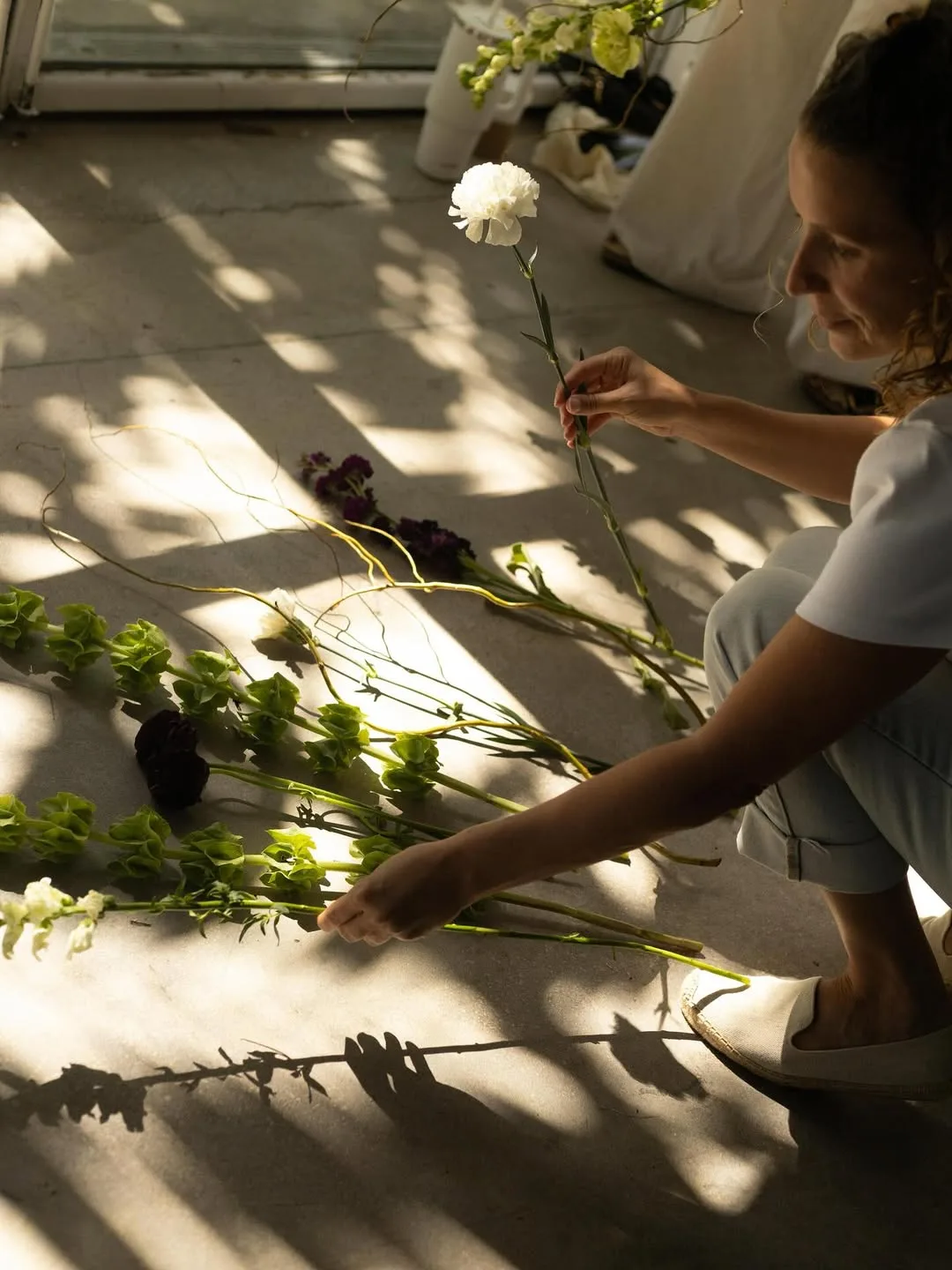
For the original feasibility study, we used ikebana (a Japanese floral arrangement practice) as the activity following the seated meditation portion of the experience.
Ikebana meets that state directly. Working with natural materials, their weight, texture, and irregularity, becomes a nervous system experience in itself. The hands engage. Attention narrows in the way it does when something genuinely absorbs us. The sequence is intentional rather than coincidental. Meditation prepares the ground. Ikebana meets it.
The study drew on three bodies of research to better understand why this process works.
Framework 01
Multiple Intelligences — Howard Gardner
Howard Gardner proposed that human intelligence is not a single, fixed measure but a constellation of distinct capacities — among them linguistic, logical, spatial, musical, bodily-kinesthetic, and naturalist intelligence. The naturalist intelligence, in particular, speaks to a person’s sensitivity to the living world: plants, seasons, texture, growth. Gardner’s framework suggests that when individuals engage in activities that align with their specific intelligences, that engagement tends to feel more intuitive, more absorbing, more natural. The study examined whether a carefully sequenced experience could engage several of these intelligences simultaneously, rather than addressing only the cognitive.
Gardner, 1983
Framework 02
Flow Theory — Mihaly Csikszentmihalyi
Csikszentmihalyi identified flow, the state of complete, effortless absorption in a meaningful activity, as one of the most consistent sources of human wellbeing. The study examined whether guided meditation, as a threshold practice, could prepare participants to enter flow more readily during the hands-on ikebana work that followed.
Csikszentmihalyi, 1990
Framework 03
Self-Determination Theory — Deci & Ryan
Deci and Ryan’s research identifies three core psychological needs underlying human motivation and flourishing: autonomy, competence, and relatedness. The study considered how each experience could be structured to meet all three giving participants genuine agency, a growing sense of skill, and the felt sense of being part of something larger than themselves.
Deci & Ryan, 1985
The Findings
What the study found
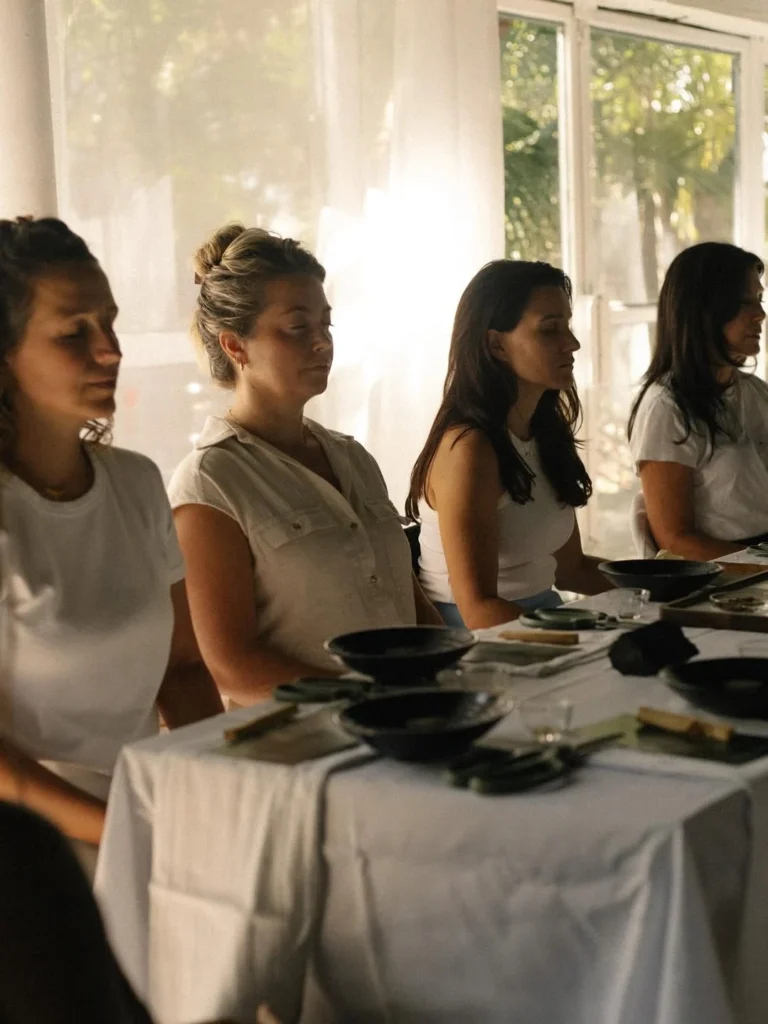
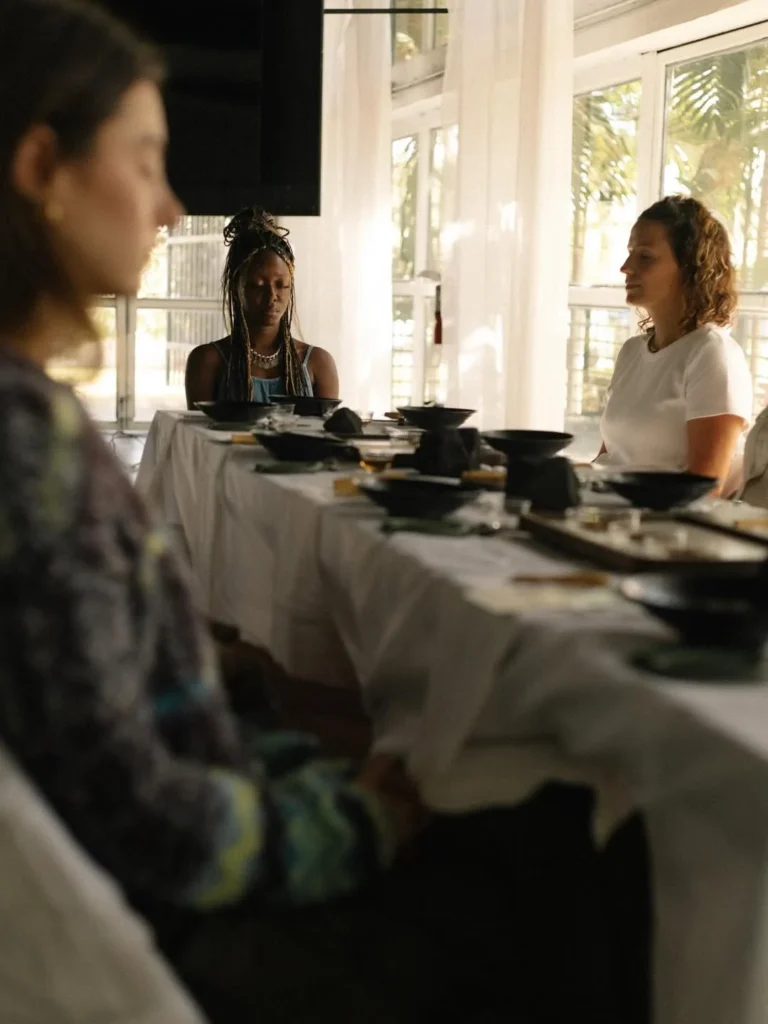
The study was carried out across a series of ikebana workshops in New York City and Miami, each attended by six to ten participants. Sessions opened with guided meditation before moving into hands-on ikebana practice.
What emerged, consistently, was a shift. Participants arrived carrying the usual weight of a full day distraction, mental noise, the difficulty of being present. By the time they were working with their hands and their materials, something had changed. The room became quiet in a different way. People moved more slowly and with more attention. The chatter that fills most group settings gave way to something closer to absorption.
The experience engaged the naturalist, spatial, bodily-kinesthetic, and intrapersonal intelligences at once. It did not ask participants to think their way into wellbeing. It invited them to arrive through the body, through material, through the simple act of making something with care.
The feasibility study confirmed what the room had already been demonstrating: that the conditions for flow and genuine restoration can be designed. That nature-based, embodied practice when held with intention creates something reliable and repeatable.
Up to 60 people moved through this work over the course of the year. They came as individuals. They left having shared something.
The Practice
What moai wellness does
The study was carried out across a series of ikebana workshops in New York City, each attended by six to ten participants. Sessions opened with guided meditation before moving into hands on ikebana practice.
What emerged, consistently, was a shift. Participants arrived carrying the usual weight of a full day distraction, mental noise, the difficulty of being present. The meditation began the work of settling that. By the time they were working with their hands and their materials, something had changed. The room became quiet in a different way. People moved more slowly and with more attention. The chatter that fills most group settings gave way to something closer to absorption.
This was not incidental. It was the sequence doing what it was designed to do guiding the nervous system from the ordinary state of a busy life into one that is open, attentive, and capable of genuine presence. The hands working with natural material its weight, its resistance, its particular life continued and deepened what the meditation had begun.
The experience engaged the naturalist, spatial, bodily-kinesthetic, and intrapersonal intelligences at once. It did not ask participants to think their way into wellbeing. It invited them to arrive through the body, through material, through the simple act of making something with care.
The feasibility study confirmed what the room had already been demonstrating: that the conditions for flow and genuine restoration can be designed. That nature-based, embodied practice when held with intention and preceded by the right kind of stillness creates something reliable and repeatable.

The Practice
What Moai does
Moai Wellness Club produces experiences grounded in the findings of that research. The programming is nature based, hands on, and sequenced with intention.
Sessions are kept relatively small by design. The work has also drawn on guided meditation, movement, breathwork, and other nature based practices each offering as its own form of threshold, its own way of returning the nervous system to a state in which something real can occur.
Moai is also engaged in an ongoing relationship with the broader research it draws from. The workshops are not simply classes.
They are a living expression of a question that has not stopped being asked:
What does it actually take for people to feel well, together?
Join the Club
Connect with us
Be the first to hear about upcoming workshops, science backed insights, and curated wellness experiences.
moaiwellnessclub@gmail.com
Social Media
@moaiwellnessclub